Please follow this link to my new (and hopefully improved) website.
www.danfeeneyracing.com

After University of Delaware cut its men's track/XC programs, I followed my dream to become a pro triathlete. Here is my story interspersed with some science. Hope you enjoy!
Thursday, June 11, 2015

Tuesday, May 19, 2015
French Creek Triathlon: Win and a CR
In the professional side of triathlon, 'times are a changin'. While a few years ago, olympic distance and half distance racing had prize purses in many series (REV 3, 5150, etc.) but as of this year, the number of races with prize purses has dwindled further to some Challenge half distances, ITU events (where one must be doing well in a world cup to break even), the full distance ironman events, and then some local races. My friend, and fellow professional triathlete/race director John Kenny, put his money where his passion is and put up a decent prize purse for a local triathlon. Because of this, I decided to race here at French Creek (1 hour away) versus Challenge Knoxville (9 hours). In the end, I ended up winning, setting a course record, and volunteering at the kids race the day before. It was a great event and I would love to see more local races putting up small purses and using local pros to their advantage (volunteering, clinics, etc.)
Here is a little recap of the race.
Swim: 18:17, 2nd behind Pierre, a solid triathlete with a swimming background from University of Pittsburgh. I tried to hold his feet to the best of my ability, and we ended up putting a solid gap into the rest of the field in the two loop swim. He exited the water 6 seconds in front of me.

 T1: 35 seconds and got out on the bike course first.
Bike:1:11:50, fastest split. The bike is a hard and hilly ride. About 2400 ft climbing during the 24.6 mile leg. My race file is here: https://www.strava.com/activities/306585561
The course is two times out and back with two significant climbs/descents each direction. I saw a speed >50 mph on my garmin on one of the downs and was happy with that. My plan was to go very hard up the hills and recover a bit down but keep spinning my legs and stay very aero. I saw by the first turn around, I had about 2 minutes on second and then 4 minutes at the half way mark. I felt like I eased up the second lap a little but was only 10 seconds slower. I came into T2 with ~9 minute lead
 Run: 36:20, fastest split by 3 mins. To try an elucidate how hard of a course this run is might be a job better suited for a dramatic poet. You climb and climb and climb for 4 miles. When you think you will turn around, you continue on a fire road path to the top of a small "peak" at French Creek around 1100 feet (Transition is 300 feet). I saw that Philly Pro Tri teammates Zach Smith and Luke Davis were in 2nd and 5th, respectively and was pretty pumped to share the podium with friends.
The other positive of these local races is representing local sponsors that help support triathlon. Kevin McCauley from Square One Investments (not only spectated, but took all of these pictures!) and all of Team Philly Pro Tri were at the race, which is fantastic as I am supremely thankful for their support.


Here is a little recap of the race.
Swim: 18:17, 2nd behind Pierre, a solid triathlete with a swimming background from University of Pittsburgh. I tried to hold his feet to the best of my ability, and we ended up putting a solid gap into the rest of the field in the two loop swim. He exited the water 6 seconds in front of me.


Bike:1:11:50, fastest split. The bike is a hard and hilly ride. About 2400 ft climbing during the 24.6 mile leg. My race file is here: https://www.strava.com/activities/306585561
The course is two times out and back with two significant climbs/descents each direction. I saw a speed >50 mph on my garmin on one of the downs and was happy with that. My plan was to go very hard up the hills and recover a bit down but keep spinning my legs and stay very aero. I saw by the first turn around, I had about 2 minutes on second and then 4 minutes at the half way mark. I felt like I eased up the second lap a little but was only 10 seconds slower. I came into T2 with ~9 minute lead

The other positive of these local races is representing local sponsors that help support triathlon. Kevin McCauley from Square One Investments (not only spectated, but took all of these pictures!) and all of Team Philly Pro Tri were at the race, which is fantastic as I am supremely thankful for their support.


Sunday, May 10, 2015
Spring 2015
I have not updated this in awhile, and I attribute that to racing not going very well and a general lack of time to get training and triathlon related things done in the winter, which caused a lack luster spring.
This winter and early spring, I had some great life related things happen: I defended my masters thesis, got accepted into a PhD program at CU Boulder in the Neurophysiology of movement lab (along with my girlfriend) and have submitted two papers for peer reviewed publication. This has however, left my triathlon and running times a bit behind. But, it is turning around!
I started with a very early season race, February 1st, in Punta Guilarte, Puerto Rico where I placed 13th, but I was really out of the race after a poor swim in big chop. I believed I was in good shape coming off a strong January but the swim was decisive and the race went down hill from there. I opted to not race Clermont/Sarasota continental cups due to a general lack of fitness as they were right around when my thesis defense was. Instead, I raced a road 5k (15:12) and two track races that did not go so well. It is interesting how a poor race can have two results: either motivate you or depress you. My first race of the year in Puerto Rico was the latter, and I was down on racing and traveling far to compete. I even took a week off riding and had very low numbers otherwise during February. After getting many academic obligations accomplished, my last track race at Penn Relays did the opposite. I was disappointed with my time, but the next day I was motivated. I put in two really solid weeks (and had been training pretty well for the 4- weeks prior). I had a fresher perspective on training and wanted to race with the goal of mentally and physically putting myself on the line. That is what I always have enjoyed most about racing, the sheer pain that brings the satisfaction of a job well done.
I raced Delaware Half marathon on Sunday, 5/10. I had a bit of pressure as defending champion, but there was a stellar field with Mo Trafeh's former training partner, Ryan Lee, Darryl Brown, Daniel Hoyne, Dave Berdan (1:05 half guy from Baltimore), and a couple of younger guys that were running well. I had been mostly displeased as a result of not really putting myself out there in races and was determined to change that trend today. I wanted to rattle the cages, stick my nose into the race, and get a lot out of myself. On a hot and (99%) humidity day, we went out in 5:04 with two africans, 15:25 at 3 miles and 26:10 at 5 miles before the hills really kick up. While I couldn't hold pace with Youffif, Dan Hoyne and I ran together until mile 10, where he put in a solid move that I could not counter. The difference today was that I put myself in that position to be up there, where in previous races I have not. I am excited to keep this trend up.
I race next weekend at French Creek tri followed by Challenge Williamsburg, Philly Tri, and Challenge St. Andrews. That brings the season to July, where I will be moving to Boulder and will reevaluate what races to do once I get settled in.
I want to thank my mom for cheering at a 7 am start on mother's day! and Melissa for coming by. Also, I am so thankful for sponsors for 2015: Square One Investments, Philly Pro Tri, PowerBar.
This winter and early spring, I had some great life related things happen: I defended my masters thesis, got accepted into a PhD program at CU Boulder in the Neurophysiology of movement lab (along with my girlfriend) and have submitted two papers for peer reviewed publication. This has however, left my triathlon and running times a bit behind. But, it is turning around!
I started with a very early season race, February 1st, in Punta Guilarte, Puerto Rico where I placed 13th, but I was really out of the race after a poor swim in big chop. I believed I was in good shape coming off a strong January but the swim was decisive and the race went down hill from there. I opted to not race Clermont/Sarasota continental cups due to a general lack of fitness as they were right around when my thesis defense was. Instead, I raced a road 5k (15:12) and two track races that did not go so well. It is interesting how a poor race can have two results: either motivate you or depress you. My first race of the year in Puerto Rico was the latter, and I was down on racing and traveling far to compete. I even took a week off riding and had very low numbers otherwise during February. After getting many academic obligations accomplished, my last track race at Penn Relays did the opposite. I was disappointed with my time, but the next day I was motivated. I put in two really solid weeks (and had been training pretty well for the 4- weeks prior). I had a fresher perspective on training and wanted to race with the goal of mentally and physically putting myself on the line. That is what I always have enjoyed most about racing, the sheer pain that brings the satisfaction of a job well done.
I raced Delaware Half marathon on Sunday, 5/10. I had a bit of pressure as defending champion, but there was a stellar field with Mo Trafeh's former training partner, Ryan Lee, Darryl Brown, Daniel Hoyne, Dave Berdan (1:05 half guy from Baltimore), and a couple of younger guys that were running well. I had been mostly displeased as a result of not really putting myself out there in races and was determined to change that trend today. I wanted to rattle the cages, stick my nose into the race, and get a lot out of myself. On a hot and (99%) humidity day, we went out in 5:04 with two africans, 15:25 at 3 miles and 26:10 at 5 miles before the hills really kick up. While I couldn't hold pace with Youffif, Dan Hoyne and I ran together until mile 10, where he put in a solid move that I could not counter. The difference today was that I put myself in that position to be up there, where in previous races I have not. I am excited to keep this trend up.
I race next weekend at French Creek tri followed by Challenge Williamsburg, Philly Tri, and Challenge St. Andrews. That brings the season to July, where I will be moving to Boulder and will reevaluate what races to do once I get settled in.
I want to thank my mom for cheering at a 7 am start on mother's day! and Melissa for coming by. Also, I am so thankful for sponsors for 2015: Square One Investments, Philly Pro Tri, PowerBar.
Monday, February 9, 2015
The simplified statistics behind the most recent running debate
Very recently, a paper was published in the American College of Cardiology Foundation about the supposed dangers of strenuous running. Alex Hutchinson, from Sweat Science did a great piece that summarizes the results well and points out potential flaws in how many are interpreting their results.
I am going to digress discussing triathlons for this entry in favor of delving into the statistics in this study that says running more than 20 MPW and fast could be dangerous. The original paper may be Found here and Alex Hutchinson's review here: http://www.runnersworld.com/health/the-supposed-dangers-of-running-too-much
This journal article has quickly gained recognition as "proof" that running too much can be dangerous for your health. While this is true (anything in excess can be dangerous), there is not enough evidence that 20 MPW is the cut off for health and overtraining. There are certainly hazards to overly stressing one's body, but those are generally outweighed with moderate exercise. The other problem is the average American is nowhere near that maximal border, and much closer to the minimal border, which is costing healthcare billions, not to mention decreasing the quality of life for many. The current state of society may need more encouragement to exercise, not excuses to skip.
In this study, a large group of individuals was followed since 2001 and assessed for mortality rates. Fairly complex statistical methods called Cox proportional hazard regression analysis was used to interpret the results because the study did not have what is referred to as a "balanced design." Without a balanced design, each group has a different number of individuals, and each group has very different vital statistics (age, BMI, etc.), and is referred to as non homogenous. Because of that, simple comparison of average death rates is not possible. In order to rectify this, certain assumptions must be made and adjustments made to their formulae that should take into account the covariate of age. There are inherent risks whenever such assumptions are made, and whenever possible, a balanced design is more helpful. For a more basic analysis of the numbers, see below.
The four groups analyzed were as follows (the number in paraenthesis being the total number of individuals in the group) 1. sedentary (413), 2. light (576), 3. moderate (262), and 4. strenuous (40). As you can see, the numbers are far from being balanced. This creates a basic problem when trying to compare averages. At the most basic comparison, one would want to compare average mortality rates across groups. (Note: the actual data analysis used Cox proportional regression analysis, but this is a simplified explanation). An simple comparison (ANOVA, or analysis of variance) would be an incorrect assessment tool because it does not take into account covariates. For this explanation, however, we will discuss the fundamental ideas behind the results.
A basic rule of statistics is, when you have a large number of subjects, you have more "statistical power" meaning you can detect smaller and smaller differences between groups. For a hypothetical example, if you have two groups of 500 individuals, and one group receives a medical intervention, where the other gets placebo. After six weeks, you can detect a relatively small difference in the effectiveness of the drugs. A difference as small as 12 people could be seen as "significant". However, if your sample size is 50, you need a far grater difference between the groups to detect a "significant" difference. "Significant" here refers to statistical significance, where you accept a 5% likelihood that your results will not detect an effect that is actually there. Whether or not statistical significance always equates to real world significance is a topic for a different entry. When you have small numbers (such as the last group), it becomes very difficult to detect small differences because there is more chance of random events affecting your results (such random events could be a death unrelated to running). If each group had 500 subjects, smaller differences could be detected, but because there are small numbers in some groups, the analysis loses statistical power. With the small sample size in the strenuous group, it becomes difficult to show if there was a significant difference in death rate from no running (which had a high sample size).
While it would be very inappropriate to compare direct proportions of deaths because the groups were very different in age groups. A simple comparison of death rates would yield:
Sedentary: 31%
Light: 1.21 %
Moderate: 3%
Strenuous: 5%
This data only gives four data points, and would suggest that doing some running, significantly decreases your death risk (you can do a simple ANOVA and see all groups are significantly better than the sedentary group). The problem is this data is misleading, but one could speculate that the root cause of misleading data is because the groups were sampled at such different age ranges. These data do not give statistically significant differences between light, moderate, and strenuous runners. One cannot tease out the effect of different starting age on death rate versus the level of running on death rate.
Using adjustment equations, the group goes on to say that a U shape curve exists where moderate exercise is optimal for lower mortality rates, but given the above data, can we be so sure we have found it? Given their survival data equations, they adjusted for age and claimed that the light running group had the lowest mortality rate. While this is fair, if you take away the sedentary group and just compare the three running groups, 1.21, 3, and 5% mortality rates, is there a glaringly obvious answer? Not necessarily because back to the original point. The groups are not evenly matched for numbers. The strenuous group only had 40 subjects and two died. If one died, 2.5% would be the death rate, and if three died, 7.5% would be the rate. Compare that to the light group, if one extra person died, the rate would change from only 1.21% to 1.39%! You would need 22 more people in the light jogging group to die for the rate to go all the way to 5%! Simple 'back of the envelope' calculations reveal that you need a much larger shift in death rates to change the death rates in the light running group.This illustrates the point of needing equal sample sizes pretty well.
When it comes down to the root of the issue, addicted runners will likely not stop running (as they love it), but it is possible to change the attitude of sedentary individuals, and they may be encouraged to exercise. The authors do not argue against exercise, and one is a doctor who freely admits exercise is very beneficial (though we are not sure of the optimal level). This data can only hurt those individuals who we need to be encouraged to exercise. News articles will read "Running; too much may be dangerous" because it is a catchy headline. They will not tout the fact that running at all made for much lower mortality rates, because that is "old" news. The research done in this article is sound research, but the interpretations are crossing into dangerous when news outlets read them! It is important to take a step back, simplify what they found, and try to understand what the data really suggests at it's core. Moderation is key for any aspect of life, and each individual is likely going to respond differently to doses of running, so don't stop exercising!!
I am going to digress discussing triathlons for this entry in favor of delving into the statistics in this study that says running more than 20 MPW and fast could be dangerous. The original paper may be Found here and Alex Hutchinson's review here: http://www.runnersworld.com/health/the-supposed-dangers-of-running-too-much
This journal article has quickly gained recognition as "proof" that running too much can be dangerous for your health. While this is true (anything in excess can be dangerous), there is not enough evidence that 20 MPW is the cut off for health and overtraining. There are certainly hazards to overly stressing one's body, but those are generally outweighed with moderate exercise. The other problem is the average American is nowhere near that maximal border, and much closer to the minimal border, which is costing healthcare billions, not to mention decreasing the quality of life for many. The current state of society may need more encouragement to exercise, not excuses to skip.
In this study, a large group of individuals was followed since 2001 and assessed for mortality rates. Fairly complex statistical methods called Cox proportional hazard regression analysis was used to interpret the results because the study did not have what is referred to as a "balanced design." Without a balanced design, each group has a different number of individuals, and each group has very different vital statistics (age, BMI, etc.), and is referred to as non homogenous. Because of that, simple comparison of average death rates is not possible. In order to rectify this, certain assumptions must be made and adjustments made to their formulae that should take into account the covariate of age. There are inherent risks whenever such assumptions are made, and whenever possible, a balanced design is more helpful. For a more basic analysis of the numbers, see below.
The four groups analyzed were as follows (the number in paraenthesis being the total number of individuals in the group) 1. sedentary (413), 2. light (576), 3. moderate (262), and 4. strenuous (40). As you can see, the numbers are far from being balanced. This creates a basic problem when trying to compare averages. At the most basic comparison, one would want to compare average mortality rates across groups. (Note: the actual data analysis used Cox proportional regression analysis, but this is a simplified explanation). An simple comparison (ANOVA, or analysis of variance) would be an incorrect assessment tool because it does not take into account covariates. For this explanation, however, we will discuss the fundamental ideas behind the results.
A basic rule of statistics is, when you have a large number of subjects, you have more "statistical power" meaning you can detect smaller and smaller differences between groups. For a hypothetical example, if you have two groups of 500 individuals, and one group receives a medical intervention, where the other gets placebo. After six weeks, you can detect a relatively small difference in the effectiveness of the drugs. A difference as small as 12 people could be seen as "significant". However, if your sample size is 50, you need a far grater difference between the groups to detect a "significant" difference. "Significant" here refers to statistical significance, where you accept a 5% likelihood that your results will not detect an effect that is actually there. Whether or not statistical significance always equates to real world significance is a topic for a different entry. When you have small numbers (such as the last group), it becomes very difficult to detect small differences because there is more chance of random events affecting your results (such random events could be a death unrelated to running). If each group had 500 subjects, smaller differences could be detected, but because there are small numbers in some groups, the analysis loses statistical power. With the small sample size in the strenuous group, it becomes difficult to show if there was a significant difference in death rate from no running (which had a high sample size).
While it would be very inappropriate to compare direct proportions of deaths because the groups were very different in age groups. A simple comparison of death rates would yield:
Sedentary: 31%
Light: 1.21 %
Moderate: 3%
Strenuous: 5%
This data only gives four data points, and would suggest that doing some running, significantly decreases your death risk (you can do a simple ANOVA and see all groups are significantly better than the sedentary group). The problem is this data is misleading, but one could speculate that the root cause of misleading data is because the groups were sampled at such different age ranges. These data do not give statistically significant differences between light, moderate, and strenuous runners. One cannot tease out the effect of different starting age on death rate versus the level of running on death rate.
Using adjustment equations, the group goes on to say that a U shape curve exists where moderate exercise is optimal for lower mortality rates, but given the above data, can we be so sure we have found it? Given their survival data equations, they adjusted for age and claimed that the light running group had the lowest mortality rate. While this is fair, if you take away the sedentary group and just compare the three running groups, 1.21, 3, and 5% mortality rates, is there a glaringly obvious answer? Not necessarily because back to the original point. The groups are not evenly matched for numbers. The strenuous group only had 40 subjects and two died. If one died, 2.5% would be the death rate, and if three died, 7.5% would be the rate. Compare that to the light group, if one extra person died, the rate would change from only 1.21% to 1.39%! You would need 22 more people in the light jogging group to die for the rate to go all the way to 5%! Simple 'back of the envelope' calculations reveal that you need a much larger shift in death rates to change the death rates in the light running group.This illustrates the point of needing equal sample sizes pretty well.
When it comes down to the root of the issue, addicted runners will likely not stop running (as they love it), but it is possible to change the attitude of sedentary individuals, and they may be encouraged to exercise. The authors do not argue against exercise, and one is a doctor who freely admits exercise is very beneficial (though we are not sure of the optimal level). This data can only hurt those individuals who we need to be encouraged to exercise. News articles will read "Running; too much may be dangerous" because it is a catchy headline. They will not tout the fact that running at all made for much lower mortality rates, because that is "old" news. The research done in this article is sound research, but the interpretations are crossing into dangerous when news outlets read them! It is important to take a step back, simplify what they found, and try to understand what the data really suggests at it's core. Moderation is key for any aspect of life, and each individual is likely going to respond differently to doses of running, so don't stop exercising!!
Monday, November 17, 2014
Physiology of Bike Training
I have wanted to follow up on a plan I wrote out for run training in triathlon (or just in general) since last year, but have been too busy! Now biking is probably my "weak" point of triathlon, but it's not for lack of understanding of how to improve, but just is a long process! Below is a good method to follow if you are just getting into building fitness on the bike.
Similar to the run, biking requires muscular and cardiovascular fitness. I separate the two types of fitness because by simply running or swimming a lot, one will build plenty of cardiovascular fitness, but it is not specific to the musculature responsible for propelling you forward on a bike. However, there are a lot of cross over gains to be achieved by high volume swimming and running, to get good at biking, one must bike a lot. In George Hincape's book, he mentions, "he who is on their bike the longest, usually prevails." Outside of doping issues, this is a realistic statement. In order to build a robust musculature and aerobic system for biking, many individuals will improve with simply 12 weeks of "base" building, where total mileage increases are the focus.
In the base phase, a lot of people think it only means long and slow riding. I do not recommend only long and slow riding because not only it is tough to stay motivated to do that, but scientifically your body needs a new stimulus every 6-8 weeks to keep adapting. During this base phase of 12 weeks, most of the riding will be easy, by necessity. If it were too hard, injuries will occur because too much volume and too much intensity is not sustainable. Take the average number of hours/week you were riding in the previous year and try to increase by as much as your schedule will allow. Personally, I rode between 8-10 hours/week in my base before, and in this build, I am trying to sustain 12-15 hours per week. It is important to not neglect your other events if you are training for triathlon, but if you are simply riding… ride away! During this base period, I have a few 'go to' workouts that break up the monotony, but should be planned on days when you will not be overly fatigued before. Examples of these workouts are:
30 minute- 1:30 'tempo' ride. Tempo is really a nebulous term that gets thrown around a lot, but I personally like to think of it as "comfortably uncomfortable." Perhaps a more finite description would be applicable, so I try to ride around 160-165 HR, which represents 70-80% of a maximal HR. The important part of these is that your power (or speed, or feeling) improves through the base phase. If you start out the year riding 30 minutes at 250 watts within this zone, hopefully you can maintain that for 1 hour or 1:30 by the end and the 30 minute tempos are now slightly better, say 275- 280 watts. For me, I like to begin the base by pacing off feeling and HR, and reading associated power numbers as my 'output.' As the season looms, power becomes the 'input' or the pace you plan to ride.
During this time, some other 'fun' drills can be employed during long rides (especially if you are forced to be on the trainer) as they can build power but also break up monotony. Power is made of two components; force and velocity. Overgear work can be useful to put your bike into a gear in which you will ride at 50-60 RPM to work on the force component of power. Undergear work can be used to boost your maximal cadence and may help with neural facilitation. Examples of this would be 10 by 30 seconds at 120-140 RPM.
After this longer base period, a robust musculoskeletal system has been crafted, and it is time to really begin to hone in on race specific training. Total mileage or hours/week will stay relatively high initially but the focus begins to shift to having more quality over sheer quantity. For the next 4-6 weeks, workouts such as 8 * 5minutes with 3 minutes recovery should be performed with the goal intensity being best average. This ideally can be measured by power output during each 8 minute interval. Recording HR data is useful to pair HR and power data ad hoc. Other workouts are variations of this: 4 by 10 minutes, 10 by 6 minutes, etc.
During this period, the weekly long ride should be continued as the increases in capiliarization are generally always beneficial. If you are training for a longer distance race, incorporating race specific pacing to these longer rides can be beneficial too. For those longer races, I believe it is crucial to maintain the "long tempo" ability to suffer, so 40 minute - 1:30 minute blocks of "tempo" riding as before are helpful. Similarly, the longer the race, the less intense the race pace should be, so these longer blocks begin to be close to race pace.
The final 'block' I want to write about includes the last 2-3 weeks prior to racing. After a longer base period and a strong interim 4-6 weeks of relatively high mileage with solid workouts, it begins time to taper or refocus depending on your season goals. If you have an "A" race coming up, now is the time to reduce mileage and increase intensity in shorter workouts such as 10 by 2 minutes with 2 minutes recovery or a pyramid of 1,2,3,4,8,4,3,2,1 with best average being the goal.
On race week, it is completely about doing what you need to succeed. A lot of people think this means take time off, but this strategy does not work for everybody. Steve Magnuss has written a few useful articles on maintaining muscle tension before races. This means we should still have that "strong" feeling about ourselves and intensity should be performed on race week, but the extraneous mileage should be decreased. I like to have my last hard workout three days prior to the race, and it includes something like 5 by 5 minutes on the bike or 1,2,3,3,2,1 fartlek running. After that, it is all about recovering for the race.
I got a lot of great feedback on my running training post, so please feel free to contact me with questions or comments.
Happy training
Similar to the run, biking requires muscular and cardiovascular fitness. I separate the two types of fitness because by simply running or swimming a lot, one will build plenty of cardiovascular fitness, but it is not specific to the musculature responsible for propelling you forward on a bike. However, there are a lot of cross over gains to be achieved by high volume swimming and running, to get good at biking, one must bike a lot. In George Hincape's book, he mentions, "he who is on their bike the longest, usually prevails." Outside of doping issues, this is a realistic statement. In order to build a robust musculature and aerobic system for biking, many individuals will improve with simply 12 weeks of "base" building, where total mileage increases are the focus.
In the base phase, a lot of people think it only means long and slow riding. I do not recommend only long and slow riding because not only it is tough to stay motivated to do that, but scientifically your body needs a new stimulus every 6-8 weeks to keep adapting. During this base phase of 12 weeks, most of the riding will be easy, by necessity. If it were too hard, injuries will occur because too much volume and too much intensity is not sustainable. Take the average number of hours/week you were riding in the previous year and try to increase by as much as your schedule will allow. Personally, I rode between 8-10 hours/week in my base before, and in this build, I am trying to sustain 12-15 hours per week. It is important to not neglect your other events if you are training for triathlon, but if you are simply riding… ride away! During this base period, I have a few 'go to' workouts that break up the monotony, but should be planned on days when you will not be overly fatigued before. Examples of these workouts are:
30 minute- 1:30 'tempo' ride. Tempo is really a nebulous term that gets thrown around a lot, but I personally like to think of it as "comfortably uncomfortable." Perhaps a more finite description would be applicable, so I try to ride around 160-165 HR, which represents 70-80% of a maximal HR. The important part of these is that your power (or speed, or feeling) improves through the base phase. If you start out the year riding 30 minutes at 250 watts within this zone, hopefully you can maintain that for 1 hour or 1:30 by the end and the 30 minute tempos are now slightly better, say 275- 280 watts. For me, I like to begin the base by pacing off feeling and HR, and reading associated power numbers as my 'output.' As the season looms, power becomes the 'input' or the pace you plan to ride.
During this time, some other 'fun' drills can be employed during long rides (especially if you are forced to be on the trainer) as they can build power but also break up monotony. Power is made of two components; force and velocity. Overgear work can be useful to put your bike into a gear in which you will ride at 50-60 RPM to work on the force component of power. Undergear work can be used to boost your maximal cadence and may help with neural facilitation. Examples of this would be 10 by 30 seconds at 120-140 RPM.
After this longer base period, a robust musculoskeletal system has been crafted, and it is time to really begin to hone in on race specific training. Total mileage or hours/week will stay relatively high initially but the focus begins to shift to having more quality over sheer quantity. For the next 4-6 weeks, workouts such as 8 * 5minutes with 3 minutes recovery should be performed with the goal intensity being best average. This ideally can be measured by power output during each 8 minute interval. Recording HR data is useful to pair HR and power data ad hoc. Other workouts are variations of this: 4 by 10 minutes, 10 by 6 minutes, etc.
During this period, the weekly long ride should be continued as the increases in capiliarization are generally always beneficial. If you are training for a longer distance race, incorporating race specific pacing to these longer rides can be beneficial too. For those longer races, I believe it is crucial to maintain the "long tempo" ability to suffer, so 40 minute - 1:30 minute blocks of "tempo" riding as before are helpful. Similarly, the longer the race, the less intense the race pace should be, so these longer blocks begin to be close to race pace.
The final 'block' I want to write about includes the last 2-3 weeks prior to racing. After a longer base period and a strong interim 4-6 weeks of relatively high mileage with solid workouts, it begins time to taper or refocus depending on your season goals. If you have an "A" race coming up, now is the time to reduce mileage and increase intensity in shorter workouts such as 10 by 2 minutes with 2 minutes recovery or a pyramid of 1,2,3,4,8,4,3,2,1 with best average being the goal.
On race week, it is completely about doing what you need to succeed. A lot of people think this means take time off, but this strategy does not work for everybody. Steve Magnuss has written a few useful articles on maintaining muscle tension before races. This means we should still have that "strong" feeling about ourselves and intensity should be performed on race week, but the extraneous mileage should be decreased. I like to have my last hard workout three days prior to the race, and it includes something like 5 by 5 minutes on the bike or 1,2,3,3,2,1 fartlek running. After that, it is all about recovering for the race.
I got a lot of great feedback on my running training post, so please feel free to contact me with questions or comments.
Happy training
Monday, September 22, 2014
Princeton 71.8
At the beginning of this year, I wrote down a few goals. I did not achieve all of them, but that is ok. Many of them were for the future, not specifically this year. One goal pertinent to this year (and really every year) was not to DNF any races unless I absolutely could't move anymore. This half ironman in Princeton was an example of a race I wanted to DNF, but I remembered my goal and soldiered through a really rough day.
 Here is an apt description of how I felt today.
Anyway, to the race. There were definitely some positive parts and good take aways from the day.
Swim: 24:09- 3rd out of the water behind super swimmer David Kahn and Drew Scott. I had the intentions of swimming lead pack, and I was very happy to be comfortably swimming in the front group sitting on Drew's feet. We took a bit of a wide line on the bouy line coming home, but I saw we had a decent gap behind us, so figured I would stay in the pack and get ready for the bike.
 At this point, I made a few rookies long course mistakes. I did not take a gel immediately out of the water and figured I would take one in the first few miles. The first few miles (read: 10) were super bumpy and I delayed the gel until 28 minutes in. I was riding with Swen Sundberg at a legal distance but then he slowed pretty down around 35K so I passed him and was solo for awhile. Came through 48.4 miles in 2:00, and I was happy to see I was still 24.2 mph and had not been caught by many on the bike. At this point, I was 8th and if the run started here, I would have had a positive outlook. The next 9.5 miles (1.5 mile long course) were really tough. I started bonking pretty badly. I took in 4 gels and two bottles of power bar drink mix, but apparently this was not enough. My last 7.5 miles were an abysmal 20 mph and I was caught by three riders going into T2 and legs were feeling like junk. 2:26 total time- 23.6 mph.
On the run, I kept thinking, I have to finish no matter how slowly I go. I started competing with Swen again and ran my 3rd mile in 5:35 and was hopeful this trend would continue. However, I was then led off course accidentally by a volunteer and lost 2-3 minutes. While I was not running fast, this hurt a good bit. Got to half was in 41:30 and started cramping in my hamstrings and quads. Just walked/ran to the finish. I was sad to see if I had run how my training had indicated (1:12-1:!3 range) I would have contended even with a poor bike split, but there are too many 'ifs' in that statement.
 This race leaves quite a bitter taste in my mouth to end an otherwise successful season. Outside of this race and a few ITU races where I was not as high up as I would have liked, I felt like I grew a good bit as a pro triathlete this year. Racing 1:53 in Philly felt like I was on a new level from the 1:56 range I had been doing for olympics. I also made a huge swim improvement from the spring until August when I was able to exit the water near John Kenny and September, where I swam lead pack at 71.8 Princeton. Up now is a break from training for a bit to tidy up some parts of my masters degree before a winter of hard training.
Thanks for reading!
Anyway, to the race. There were definitely some positive parts and good take aways from the day.
Swim: 24:09- 3rd out of the water behind super swimmer David Kahn and Drew Scott. I had the intentions of swimming lead pack, and I was very happy to be comfortably swimming in the front group sitting on Drew's feet. We took a bit of a wide line on the bouy line coming home, but I saw we had a decent gap behind us, so figured I would stay in the pack and get ready for the bike.
On the run, I kept thinking, I have to finish no matter how slowly I go. I started competing with Swen again and ran my 3rd mile in 5:35 and was hopeful this trend would continue. However, I was then led off course accidentally by a volunteer and lost 2-3 minutes. While I was not running fast, this hurt a good bit. Got to half was in 41:30 and started cramping in my hamstrings and quads. Just walked/ran to the finish. I was sad to see if I had run how my training had indicated (1:12-1:!3 range) I would have contended even with a poor bike split, but there are too many 'ifs' in that statement.
Thanks for reading!
Sunday, August 17, 2014
Luray Triathlon Double (Olympic and Sprint)
This past weekend, I went down to Luray, Va for the Luray Triathlon. http://luraytriathlon.com
For the first time, they were putting up an elite prize purse for both the olympic and sprint distances held on saturday and sunday, respectively. The break down was 600- 400- 250 for males and females.
I love when local races do this because it adds another dimension to the field- making it more competitive and really legitimizing the sport, as well as allowing local pros to connect with local racers. I held an open water swim clinic and transition clinic that help newer triathletes become fans of the sport and become more comfortable with the race. i had 40 people attend the transition clinic and many were first timers. When you can make first time racers feel more comfortable before race morning, it will allow them to relax, have a better experience, and get more into the sport. With a lot of talk recently discussing the value of professional triathletes- I think this is a good example of benefits of having pros.
It was great to get some solid racing in for two days in the mountains and come away with two wins and course records. Sharing the podium with John Kenny, Steven Rosinski, and Matias Pavecino.
Now to the race. Luray, Va is in a beautiful location nestled near Shenandoah National Park and provided a tough and hilly bike and run course.


For the first time, they were putting up an elite prize purse for both the olympic and sprint distances held on saturday and sunday, respectively. The break down was 600- 400- 250 for males and females.
I love when local races do this because it adds another dimension to the field- making it more competitive and really legitimizing the sport, as well as allowing local pros to connect with local racers. I held an open water swim clinic and transition clinic that help newer triathletes become fans of the sport and become more comfortable with the race. i had 40 people attend the transition clinic and many were first timers. When you can make first time racers feel more comfortable before race morning, it will allow them to relax, have a better experience, and get more into the sport. With a lot of talk recently discussing the value of professional triathletes- I think this is a good example of benefits of having pros.
 |
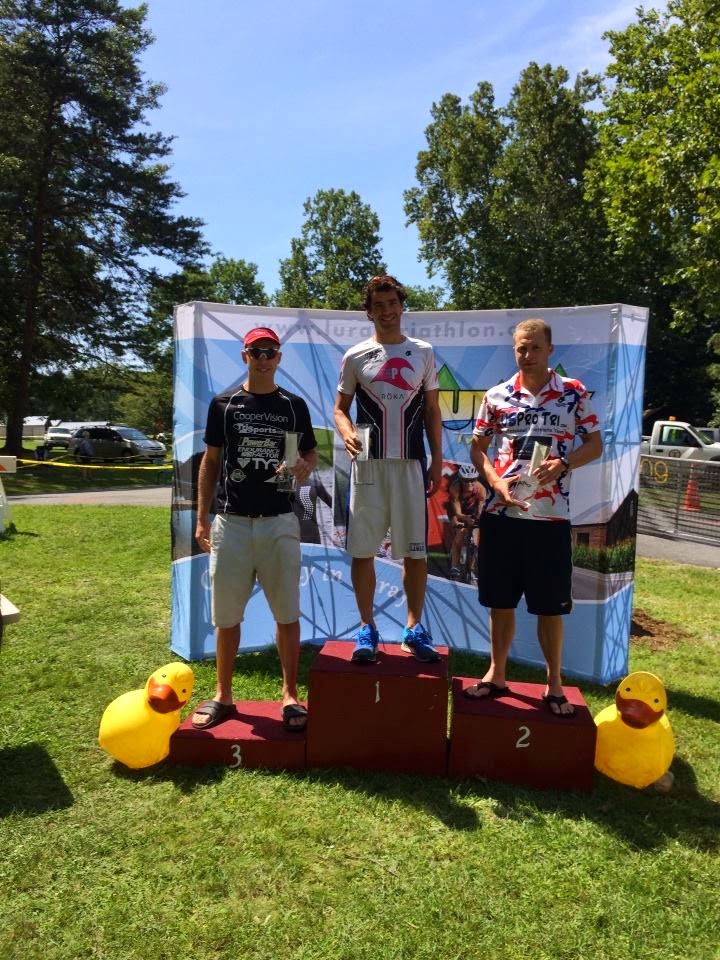

Now to the race. Luray, Va is in a beautiful location nestled near Shenandoah National Park and provided a tough and hilly bike and run course.
 |
| Beautiful Shenandoah pre race |
I initially had intended on racing in Kewlona, Canada for the ITU continental cup to chase some much needed ITU points, however, when this race popped up with the prize purse. I made a change about two weeks prior to race here instead. My rational was that I could drive there, make more money than in Kewlona and the race director was allowing me to run a transition clinic, which I enjoy doing. I was a bit leery prior to the race as I could not bike or run the monday- wednesday before the race due to hamstring and knee pain. I rested it, swam a couple double swims in the pool, and thankfully was feeling ok by Thursday to start riding again. I have chronically tight quads, so I just let stretching lapse and the pain came on pretty strong Sunday after a long run. I am very glad to have it taken care of quickly.
The Olympic race on Saturday started with 48 degree air temps and I was glad I whimsically brought my toe covers for my cycling shoes thinking there was a small chance of cold weather. The other cool thing about the Olympic race was my childhood friend, Travis Peck, was competing in his second ever triathlon, so I got to hang out with him as he got ready to go. That helped ease any nerves that may have been there.
 |
| Racing with a friend is always fun |
Swim: 19:10 1500m (2nd 18 seconds behind leader) I had studied who was racing in the pro/elite wave and knew that John Kenny would be a tough swimmer (former national 25K OW champ and one of the fastest tri swimmers I know of), so I just planned to hold his feet as long as I could. It was a wetsuit swim in a pretty warm lake (magical 77* water temps) that made the swim quite hot, but I felt good in my Roka Maverick- I am continually amazed by how comfortable that suit is. I managed to hold John's line for 1k or so, and by the end of 1500m he got 18 seconds on me. I was stoked about this as this showed all my swimming work this summer has paid off. We got over one minute on the next swimmer and 3- minutes on Steve, who would end up third today. On the 500 meter run to transition, I made up some time on John and we set out biking about 10 second apart.
Bike: 1:06:08 for 26.5 miles (3rd best split): Here is a link to my bike file with HR data. http://www.strava.com/activities/181095131
As you can see from the elevation profile, the race has some very solid hills. To get an idea of how fast the downs and steep the ups could be, I hit 50 MPH on the first downhill and on the way up, it was 12-14% grade going up. The course is a lollypop style with two circles of about 14KM. I just tried to hold as close to John on the downhills as he gapped me on them, but I was able to get some time back uphills. John said that is from extra time at the buffet line and simple physics. Anyway, got back to T2 about 90 seconds down on John and had about 1:30-2' on 3rd place.
Run: 34:11 for 10K, fastest split in the race by 1:05. On the run, I set out fairly hard to catch John. The course is two laps with 2.5K being rolling but net downhill and the opposite coming back. I figured I could roll on the downs and not feel too beaten up. I ran 5:05 and 5:10 for my first two miles and caught John at 2.5 miles. At this point, I tried to get to the turn around well (5:44 for the uphill mile) and then run conservatively to maintain the lead but not be too beaten up for the next day's race. I crossed the line in 2:01:40- a new course record by about 3 minutes and happy that I had won $600 plus an engraved wine craft.
The next day, I lined up for the sprint race. It was going to be a harder race for me since the bike was on the long side (17.4 miles) compared to the swim and run- and I knew there were some bike specialists that were looking to capitalize. Because of this, my goal was to swim with John (or close) and hold everybody within striking distance on the run.
Swim: 9:38 (750m), 2nd 15 seconds behind John. This was pretty similar to day one except more pain chasing John around the lake. My arms immediately hurt and I knew I wasn't swimming much slower, it just hurt more. We exited and I looked back, relieved to see that we had a solid 90 second gap on the main players.
Bike: 44:01 for 17.4 miles (3rd best). The bike course is the same as the Olympic, but only one 14 KM loop. You still get 1200 ft climbing over this short distance, so it is not a fast overall course. I do have my bike computer split every 5 miles, and my second 5 miles was 10:30 or 29 mph average, giving an idea of how up AND down the course is. I again chased John around the course and managed to catch him at the top of the very last hill, 500 meters before transition. At this point, I noticed Matias had also bridged up and we were all entering T2 together. http://www.strava.com/activities/181657311
I got into T2 second but used the ITU skills to get out 1st. I got out onto the run pretty hard running 5:00 for the first mile
Run: 17:00 for fastest split- not really sure how long it was 3.2 or 3.3 mi probably. I just tried to carry a hard pace the whole first 3km and then let myself enjoy leading a bit. I came down the finish shoot and was relieved to be done two races in two days. 2250m swimming, 47 miles biking, and 9.5 miles running racing is a good weekend, plus another $600 helps tremendously.
I finished in 1:13:04- another course record by about 90 seconds!
I am really grateful to David Glover, the race director for putting the race on and putting up an elite purse. It was a great race that was immersed in the community and had lots of local support. I will certainly be back.
As always, thanks to Powerbar, Team Philly Pro Tri, Champ Sys, and Roka for supporting me and very importantly, my mom who came to support me at both races and volunteered as a body marker at the races. Time to finish a bigger training block before Princeton 70.3
Thursday, August 14, 2014
Pre Luray Triathlon
Just a quick heads up for anybody racing the Luray Triathlon festival this weekend in Virginia, I will be there Friday and Saturday evenings giving transition and open water swim tips.
http://luraytriathlon.com/2014/07/pro-triathlete-dan-feeney-to-race-at-luray-triathlon/
Short interview I did with the race director about the race. Hope to see many people out there!
Report of the race to follow!
http://luraytriathlon.com/2014/07/pro-triathlete-dan-feeney-to-race-at-luray-triathlon/
Short interview I did with the race director about the race. Hope to see many people out there!
Report of the race to follow!
Sunday, July 20, 2014
Canadian Double
The last 10- days have been quite a whirlwind of traveling (1700 miles) and racing (2 continental cups and 1 local fun race). My mom, girlfriend, and I departed from Delaware the Thursday before the Toronto continental cup, drove to Rochester and spent the night at Melissa's parents, drove to Toronto, raced Saturday, drove to Watertown, NY Saturday night then Lake Placid Sunday morning, where we stayed until the following Friday. Then we headed to Quebec for the Magog continental cup. I have to first thank my mom and girlfriend, Melissa, for embarking on this long trip with me. It was great to have company and support!
These two races were initially races that I had targeted to really try to peak for. Unfortunately as elite sport goes, you do not always get exactly what you want, but you have to endure. As Winston Churchill said, "if you find yourself going through hell, keep going."
Toronto: I felt a bit underprepared logistically for this race as we had no chance to preview any part of the course as Toronto is quite a major city. We were told the water was about 18 C and would be a wetsuit legal swim in Lake Ontario. Over the night, the bay must have flipped as the water was close to 14 C and quite cold. There were 51 men lined up for the elite start. I felt like I got out well, made some moves around people when I felt them slowing and for 1K, really was sitting in good position. At this point, two athletes in front of me veered off hard to the right towards a marker bouy that we did not need to go around, and a gap was formed from where they left. that minuscule gap grew and I ended up getting out in 19:30 with the last person making the lead pack in 19:18.
I chased really hard for two laps with two Canadians and we caught a few stragglers, but we did not have much organization. Guys would take a hero pull and gap the group and then not be able to pull through the next time. This made for quite a frustrating ride. We had 7 laps with two 180s and a 200 meter hill at 15% each lap to navigate. My legs just felt fried and I did not have the run I know I should be capable of. I ended up 24th. Not where I wanted, but I have improved my swim immensely. I just need another 1-2 % improvement to be there.


 (my pool for the week)
 after a nice trail run to Marcy Dam
These two races were initially races that I had targeted to really try to peak for. Unfortunately as elite sport goes, you do not always get exactly what you want, but you have to endure. As Winston Churchill said, "if you find yourself going through hell, keep going."
Toronto: I felt a bit underprepared logistically for this race as we had no chance to preview any part of the course as Toronto is quite a major city. We were told the water was about 18 C and would be a wetsuit legal swim in Lake Ontario. Over the night, the bay must have flipped as the water was close to 14 C and quite cold. There were 51 men lined up for the elite start. I felt like I got out well, made some moves around people when I felt them slowing and for 1K, really was sitting in good position. At this point, two athletes in front of me veered off hard to the right towards a marker bouy that we did not need to go around, and a gap was formed from where they left. that minuscule gap grew and I ended up getting out in 19:30 with the last person making the lead pack in 19:18.
After arriving in Lake Placid, I decided that whenever I decide it's time to race an ironman, I want to race this one. It is such an awesome mountain town with a nice small town feel but lots of things to do.
Monday night, the hotel where I stayed advertised a mini triathlon that I thought would be cool to watch. All through the day Sunday and Monday, however, people kept saying how it was a very fun little event that has gone on for 31 years for 8 mondays in the summer and was more relaxed. I decided I would use it as a workout even though I was not feeling great for two days post race.
I lined up in the water for the 400 m swim/12 mile bike/3 mile trail run and just figured I would go hard and have fun. A professional training for Ironman Lake Placid also came, Jesse Vondrasic, and I figured we would have a nice race (although my road bike versus his TT bike would likely make me hurt). I got a good minute lead in the swim but was eventually caught on the ride.
I used my training wheels for the race to get power numbers, and I was happy that I averaged 320 watts for the 30 minute ride that had good climbing and descending- giving an NP of 332 watts. I chased hard on the run- going 15:50 for 3 miles on trails but Jesse still had me by 2 seconds. We broke the existing course record and had a nice time. I got to meet a lot of the local athletes and the bike shop people. Overall, I was happy to do this. For the rest of the week, I just focused on recovering and taking in the sights.
(my pool for the week)after a nice trail run to Marcy Dam
The second race was the following Saturday in Magog. This is where I scored my first ITU points to get a world ranking came two years ago in an olympic distance race. This year, it was a difference course for a sprint, but still a race I really love. There is a solid 300 ft climb each lap followed by a technical descent where you easily hit 40 MPH. Again, I felt good I lined up in the far right next to Andrew Bysice and Kaleb VanOrt. I got out well for the beach start swim and found myself leading our side. The left side was a faster swimming side with super swimmers Hunter Lussi, Alex Lepage, and Andrew McCartney, so at the bouy, we had a melee as usual.
I got stood up here and fought through. I again lost a little time on the leaders, which proved to be devastating to the race. I was out in 9:20, with the last athlete in the lead pack at 9:16. I chased hard again but just missed that group. We had a large chase pack but only 3 or 4 of us would take strong pulls at the front. I got off the bike determined to have a good run after running poorly last week. I caught a few guys from the main bunch with a 15:40 5k but was 90 seconds down to start the run, so again ended up 24th.
Overall, I am not happy with the results of these two races, but I have to look at the positives. I have been swimming well and am closer than I ever have been off that front pack. As the Olympic cycle is in full swing, these races are getting very competitive. I want to be racing in the front, so I know I just need to keep my head down and continue working. I did decide I would change things up and am racing Princeton 70.3 in September. I think it's a nice race that I can do well in and it is close by. After that, I may try to enter a late season world cup or continental cup. Until then, I will keep thinking, "every champion is just another person who refused to give up."
Wednesday, June 25, 2014
Philly Tri 2014
I have raced Philly Tri for the last three years and have never really had a performance where I was really proud of the whole race. I finally changed that this year and really felt like I put together a full race. Here's how it went.
It's great to be able to sleep at home before a race, and because of that and the short 45- minute drive to race site caused no nerves and I was pretty relaxed pre race.
Got to check out the swim course from both ends by looking up and down river. The swim has been a point of controversy the last few years with last year, many athletes taking a different path than me, and I was dropped. Two years ago, 17- women were misguided and accidentally cut the course. Because of these previous snafu's, I wanted to really understand the course. I wanted to swim with the main group, and if I accomplished that, I would be fairly happy for the day. I have been swimming 30+ km/week for the last few weeks to really try to take my swim to an elite level. I did not back off for this race because my main focus are the two Canadian continental cups in July, so I was not sure how I'd feel. I managed to feel really strong through the entire race, just need to rest up for some more top end speed.
The swim started pretty fast for a non drafting race and I immediately found myself at hip level with some of my competitors including super fish Cam Dye and John Kenny. I just tried to stay with the main bunch as these guys were heading off the front. I made a few surges to stay with the group but mostly was just sitting in the middle of a larger bunch of athletes. I noticed a sleeved athlete next to me, who I recognized as Mark Bowstead from New Zealand and I knew he was a solid swimmer- so I was content to stay there. We exited with a large group including myself, Jason West, David Thompson, Mark, and James Thorpe. Exited in 17:34- one minute off Dye, Potts, and Kenny.
Once on the bikes, I tried my hardest to stay within site of Thompson and Bowstead, but my legs were not having it. I was in a second group with an Aussie and a few others. We eventually caught Matty Reed and closed time on Paul Matthews. I hopped off the bike with Reed and felt pretty solid for the run. Bike split was 1:00:23- which is my best Philly split by 2:30. After the race, I told Matty that it was an honor to get off the bike with him as he is really a legend who I have looked up to for awhile.
I immediately got out hard on the run and gapped Matty quickly with my goals up the road. I did not pass anybody from 1/2 mile until 5.5 miles where I caught Paul Matthews, John Kenny, and Brooks Cowan. I was able to drop all but Brooks to finish 9th overall with the 4th best run split, 34:40- however I, and a few others, had it as closer to 6.45 miles. Overall time was 1:54:15, which would have been top 5 almost every other year, so I am pretty happy with how this race went and shows good signs for continental cups in 3 and 4 weeks.

I did have a pretty funny mishap with water, where I tried to drop some on my head but the centripetal force just carried the cup high into the air, and it was caught on video!

It's great to be able to sleep at home before a race, and because of that and the short 45- minute drive to race site caused no nerves and I was pretty relaxed pre race.
Got to check out the swim course from both ends by looking up and down river. The swim has been a point of controversy the last few years with last year, many athletes taking a different path than me, and I was dropped. Two years ago, 17- women were misguided and accidentally cut the course. Because of these previous snafu's, I wanted to really understand the course. I wanted to swim with the main group, and if I accomplished that, I would be fairly happy for the day. I have been swimming 30+ km/week for the last few weeks to really try to take my swim to an elite level. I did not back off for this race because my main focus are the two Canadian continental cups in July, so I was not sure how I'd feel. I managed to feel really strong through the entire race, just need to rest up for some more top end speed.
The swim started pretty fast for a non drafting race and I immediately found myself at hip level with some of my competitors including super fish Cam Dye and John Kenny. I just tried to stay with the main bunch as these guys were heading off the front. I made a few surges to stay with the group but mostly was just sitting in the middle of a larger bunch of athletes. I noticed a sleeved athlete next to me, who I recognized as Mark Bowstead from New Zealand and I knew he was a solid swimmer- so I was content to stay there. We exited with a large group including myself, Jason West, David Thompson, Mark, and James Thorpe. Exited in 17:34- one minute off Dye, Potts, and Kenny.
Once on the bikes, I tried my hardest to stay within site of Thompson and Bowstead, but my legs were not having it. I was in a second group with an Aussie and a few others. We eventually caught Matty Reed and closed time on Paul Matthews. I hopped off the bike with Reed and felt pretty solid for the run. Bike split was 1:00:23- which is my best Philly split by 2:30. After the race, I told Matty that it was an honor to get off the bike with him as he is really a legend who I have looked up to for awhile.
I immediately got out hard on the run and gapped Matty quickly with my goals up the road. I did not pass anybody from 1/2 mile until 5.5 miles where I caught Paul Matthews, John Kenny, and Brooks Cowan. I was able to drop all but Brooks to finish 9th overall with the 4th best run split, 34:40- however I, and a few others, had it as closer to 6.45 miles. Overall time was 1:54:15, which would have been top 5 almost every other year, so I am pretty happy with how this race went and shows good signs for continental cups in 3 and 4 weeks.
I did have a pretty funny mishap with water, where I tried to drop some on my head but the centripetal force just carried the cup high into the air, and it was caught on video!
Monday, June 2, 2014
Black Bear Half Ironman- Win and Course Record
After deciding not to do Dallas continental cup because training had been hit or miss, especially in the pool, due to school and work obligations, I wanted to get a good long training block in. Team Philly Pro Tri had a team race up in the Pocono Mountains called Black Bear triathlon and I figured I would do the Olympic race there but was somehow talked into doing the half as a great training day. My last half, Savageman, did not end up so well as I did not have enough food to keep myself from bonking on the ride, so I was hoping to solve that issue and have a good day across the board. Mission was mostly accomplished. I will say, however, that the Monday before the race when I decided I should do a 50- mile ride on the TT bike to get used to the race distance on that bike, I was quietly cursing Brett for coaxing me into this! Sorry Brett, rescnded now.
My mom and girlfriend came up to watch the race too, which is nice to have everyone around since most ITU races are a good distance away, so this was a nice change. Melissa even tried on the aero helmet- maybe she will race one of these soon! Big shout out to her for breaking UD's school record in the steeplechase last week (we both used to be top 5 in school history.. guess she decided that it was time to move up).
 The day before the race, we drove the course and I expected it to be hilly, but this was very hilly. I generally climb well and race well on hills, so that was encouraging, however it reminded me a little of Savageman (just consistent hills though, no 1.5 mile stretched over 10% like SM). Was pretty relaxed about the race as I figured my heart would never be pounding over 200 BPM like the REV3 Super sprint last weekend!
Swim: 24:51 (1st) with about 2:20 on the next athlete. Swim was nice to be in the ROKA wetsuit, and I have been swimming open water the last few weeks, so I really enjoyed it. I also have been swimming with Univ of Delaware's swim team for a few weeks, so the 30-40 km/ week i have been swimming has forced me to at least enjoy swimming a little. Was able to stay really relaxed and exit the water feeling pretty calm. Quite the difference from ITU racing where I am used to being pummeled trying to hold onto the pack. Took my first (of many) power bar gels in T1.

Bike: 2:43 (1st I think) the website has me listed as 3rd but nobody's times below are listed as 1 and 2 so we will go with this. As Tim said, the first lap was nice with so many athletes around, it did not really take much mental fortitude to stay focused. The only hold ups were on some descents where I wanted to pass but had to wait. Overall, I liked the course with the exception of an hour and back that only the half does. It is about 3- miles and on some really beaten up roads with trees shading the path, making it quite difficult to see the potholes. CGI does a good job of spray painting the potholes, but some parts of the road were covered in spray paint because you could not really avoid the holes! The second loop was definitely more mentally tough as I only passed a few half athletes that were on their first loop. I do not have a power meter on my bike so I just went with RPE and focused on staying within myself. Took a gel every 35 minutes on the ride plus 24 oz of perform. Only having a spot for one bottle on my bike shows my lack of long course racing/preparation. The 5- gels I took seemed to keep me at bay and did not have any real issues energy wise on the bike, although was more than happy to get off the bike at the end! I took 2- double latte gels (with 30 mg caffeine) and 3- kona punch gels with no caffeine.

Run (1:30 for 4th or 5th again with the timing anomalies). This was an interesting run as I really have never been racing for this long, so I did not know what to expect. I put on my shoes and figured I would just treat it as a long run at first and see how it went. My error here was not bringing 1 more gel, as that would probably have made the last 4- 5 miles easier. I went out and ran 6:00 and 5:24 (downhill) and ran the next 4 miles all around 6:00-6:20.. then around half way the bottom started to drop out and my quads were cramping up pretty badly. I timed the gap to second and I had 12- minutes, so I started walking the aid stations and relaxing the downhills. As Tim said, some were pretty gnarly so I did not want to get a full blown quad issue.An athlete that was on his first loop kept telling me how I could be running faster as I passed him and then again on an out/back part. I know he was trying to help but I was not really having any of it. I was just in survival mode. When I got to the finish, I found out that I broke Josh Beck's course record by 5- seconds, and I do not think I've been so happy to be done a race for awhile. Do not think i will become a long course guy for awhile, but this was a nice race and I am glad to almost got the whole race down successfully. Congrats to all the other Philly Pro Tri athletes that seemed like they had great races too!
.jpg)
I was mostly mustering enough energy to not walk the finishing shoot, however it was nice to break the tape in 4:42 for an 11- minute win and 5- second course record.
 Now I am on a training block since school has ended. My big races are the two continental cups in Canada in July, but I will also be racing Philly Tri in 3- weeks. I am heading to Boulder before that for training/visiting CU for a potential PhD program so hopefully will have some nice new scenery for training.
My mom and girlfriend came up to watch the race too, which is nice to have everyone around since most ITU races are a good distance away, so this was a nice change. Melissa even tried on the aero helmet- maybe she will race one of these soon! Big shout out to her for breaking UD's school record in the steeplechase last week (we both used to be top 5 in school history.. guess she decided that it was time to move up).
Swim: 24:51 (1st) with about 2:20 on the next athlete. Swim was nice to be in the ROKA wetsuit, and I have been swimming open water the last few weeks, so I really enjoyed it. I also have been swimming with Univ of Delaware's swim team for a few weeks, so the 30-40 km/ week i have been swimming has forced me to at least enjoy swimming a little. Was able to stay really relaxed and exit the water feeling pretty calm. Quite the difference from ITU racing where I am used to being pummeled trying to hold onto the pack. Took my first (of many) power bar gels in T1.
Bike: 2:43 (1st I think) the website has me listed as 3rd but nobody's times below are listed as 1 and 2 so we will go with this. As Tim said, the first lap was nice with so many athletes around, it did not really take much mental fortitude to stay focused. The only hold ups were on some descents where I wanted to pass but had to wait. Overall, I liked the course with the exception of an hour and back that only the half does. It is about 3- miles and on some really beaten up roads with trees shading the path, making it quite difficult to see the potholes. CGI does a good job of spray painting the potholes, but some parts of the road were covered in spray paint because you could not really avoid the holes! The second loop was definitely more mentally tough as I only passed a few half athletes that were on their first loop. I do not have a power meter on my bike so I just went with RPE and focused on staying within myself. Took a gel every 35 minutes on the ride plus 24 oz of perform. Only having a spot for one bottle on my bike shows my lack of long course racing/preparation. The 5- gels I took seemed to keep me at bay and did not have any real issues energy wise on the bike, although was more than happy to get off the bike at the end! I took 2- double latte gels (with 30 mg caffeine) and 3- kona punch gels with no caffeine.
Run (1:30 for 4th or 5th again with the timing anomalies). This was an interesting run as I really have never been racing for this long, so I did not know what to expect. I put on my shoes and figured I would just treat it as a long run at first and see how it went. My error here was not bringing 1 more gel, as that would probably have made the last 4- 5 miles easier. I went out and ran 6:00 and 5:24 (downhill) and ran the next 4 miles all around 6:00-6:20.. then around half way the bottom started to drop out and my quads were cramping up pretty badly. I timed the gap to second and I had 12- minutes, so I started walking the aid stations and relaxing the downhills. As Tim said, some were pretty gnarly so I did not want to get a full blown quad issue.An athlete that was on his first loop kept telling me how I could be running faster as I passed him and then again on an out/back part. I know he was trying to help but I was not really having any of it. I was just in survival mode. When I got to the finish, I found out that I broke Josh Beck's course record by 5- seconds, and I do not think I've been so happy to be done a race for awhile. Do not think i will become a long course guy for awhile, but this was a nice race and I am glad to almost got the whole race down successfully. Congrats to all the other Philly Pro Tri athletes that seemed like they had great races too!
I was mostly mustering enough energy to not walk the finishing shoot, however it was nice to break the tape in 4:42 for an 11- minute win and 5- second course record.
Monday, May 26, 2014
REV 3 Rush- 3rd Place
To begin, this is my first true podium in a professional triathlon race, so I am really happy with that. Coming into this weekend, training had not been going great because I was busy with school finishing my thesis proposal and finals, but I was excited to race the super sprint distance as I really love the high intensity heavy breathing feel of it. REV 3 was having the elite race be broken down into prelims on Saturday consisting of a 250 ish meter pool swim- 5 mile bike- 1.5 mile run and Sunday doing the course twice. Top 7 in each heat would advance to finals. The pool was a bit tricky to navigate with nothing on the bottom for depth perception, you needed to count strokes and/or sight to do turns but that was helped in the finals with putting cones near the walls. The bike course was simply around the NASCAR track, which was pretty sweet! flying around those banked turns in a group at 30 mph was great, and the run zig zagged two laps inside the track where you always had spectators cheering.
 This picture gives a good idea of how the pool was different from a competitive swim race but I liked it. It was nice to still get waves and have some elements of open water in the swim.
Prelims on Saturday are always a bit nervous as the goal is just to advance as easily as possible to finals but you still have all the nerves because this race location and all was so unfamiliar. The first swim ended up going really well and I exited the water 5-7 seconds back of Eric Limkemann and Colin O'Brady- two former all american (I believe) swimmers in college. I chased hard for two laps but did not get any closer than 10 meters behind them. I looked back and saw a group of three were coming up, so I sat up and was absorbed and figured it would be better to relax before the run especially with knowing I could outrun many in the group. After a bit of confusion on the number of laps, we got into T2 and off on the run. I ran about 800 meters pretty hard and just cruised in the rest for 3rd in my heat and advanced to finals.
 The pack from the first day. We worked pretty well and was nice to be feeling spry heading into finals.
That night, I slept 11- hours and woke up feeling pretty refreshed. I went for an easy 20 minute run in the morning since finals weren't until 1:30 pm and felt fantastic.
Finals were going to be much more competitive and had 15 pretty strong athletes on the line with a combination of fast runners, swimmers, and bikers. I lined up in lane 6, in between John Kenny and Colin O'Brady and we were off. I got out hard the first 50 and flipped even with Colin and John and had delusions of grandeur that I would stay swimming with them. In the end, they put 8- seconds on me in swim number one, but I just began drilling it on the bike and caught to lead pack of 7 two laps in with two really hard solo laps with my feet on top of my shoes. I went straight to the front as I wanted to keep the pace on knowing some fast runners were behind me. I got a few shout outs from the announcer for immediately going to the front and we had a few guys really willing to take hard pulls like John and Colin and Eric but we also had guys that would only attack on their pulls going off to the side and trying to take a flier. Not really a great strategy in ITU because 1. the pack does not appreciate it and 2. it hurts the pack. None of those stuck and we were caught by three others, making a pack of 11 heading into T2.
I got out of T2 in 5th or 6th and made my way into 3rd feeling very comfortable but running hard. Knowing the second swim is important in these races, I did not want to cook myself too early. Three of us had a solid 15- second gap (Justin Roeder, Jason West, had 10 seconds to myself) as we got to T3. When I went to put my goggles back on, they snapped and I did the second swim with no goggles. The second swim already hurts quite a lot but with eyes burning, it hurt a little more. I lost some valuable time due to that and exited the swim with my lane buddies, John and Colin. We bridged back up to Eric Limkemann and Justin and entered the final T5 together in a pack of 7 or so. We had lapped a few guys who were in our group, so it was a bit hard to understand who was a lap down or not. I made sure to get some water in on this ride and get ready to run. I got into T5 and instead of racking our bikes, volunteers were taking them from us! I ended up getting hit by a bike from an over eager volunteer so I think it would behoove them to keep a standard racking procedure in the future. T5 was further worsened by my racing flat insoles being bunched up, so I took both of them out and into the basket and ran without them. Got out of T5 in 7th with Jason West having been in a break on the bike. I moved into 4th relatively quickly and slowly reeled in 3rd with about 800 meters to go. I tried to really sprint with 400 to go as 3rd was a podium and double as much money as 4th.
My Mom still does not know how she made this video go into slow motion, but it ended up looking pretty cool as I was mid sprint for the line. I ended up having been in the fastest bike group for both rides and running the 3rd best combined run splits (7:08 first run and 7:01 second) for 1.5 miles (4:45 and 4:41 pace). Finishing 3rd was pretty sweet and was a great way to start off the summer season.

Prelims on Saturday are always a bit nervous as the goal is just to advance as easily as possible to finals but you still have all the nerves because this race location and all was so unfamiliar. The first swim ended up going really well and I exited the water 5-7 seconds back of Eric Limkemann and Colin O'Brady- two former all american (I believe) swimmers in college. I chased hard for two laps but did not get any closer than 10 meters behind them. I looked back and saw a group of three were coming up, so I sat up and was absorbed and figured it would be better to relax before the run especially with knowing I could outrun many in the group. After a bit of confusion on the number of laps, we got into T2 and off on the run. I ran about 800 meters pretty hard and just cruised in the rest for 3rd in my heat and advanced to finals.
That night, I slept 11- hours and woke up feeling pretty refreshed. I went for an easy 20 minute run in the morning since finals weren't until 1:30 pm and felt fantastic.
Finals were going to be much more competitive and had 15 pretty strong athletes on the line with a combination of fast runners, swimmers, and bikers. I lined up in lane 6, in between John Kenny and Colin O'Brady and we were off. I got out hard the first 50 and flipped even with Colin and John and had delusions of grandeur that I would stay swimming with them. In the end, they put 8- seconds on me in swim number one, but I just began drilling it on the bike and caught to lead pack of 7 two laps in with two really hard solo laps with my feet on top of my shoes. I went straight to the front as I wanted to keep the pace on knowing some fast runners were behind me. I got a few shout outs from the announcer for immediately going to the front and we had a few guys really willing to take hard pulls like John and Colin and Eric but we also had guys that would only attack on their pulls going off to the side and trying to take a flier. Not really a great strategy in ITU because 1. the pack does not appreciate it and 2. it hurts the pack. None of those stuck and we were caught by three others, making a pack of 11 heading into T2.
Monday, May 12, 2014
2014 Delaware Half Marathon
Question from a reporter after that race, "Why did you do this event if you're focused on triathlon?"
Me: "You have to be good at running and suffering in triathlon, so a hilly half marathon is good practice!"
So i decided to sign up for the Delaware half marathon for a few reasons, one of which was that it was great to race a local event that has grown by leaps and bounds. There were 1300 half marathoners, 700 marathoners, and loads of 4- person and 8- person relays. There was also a good prize purse for first and extra incentive to run fast.
I had not done a specific half marathon prep at all, actually, almost the opposite where I came off a taper for a sprint triathlon two weeks ago in Barbados. I wanted to put in a big training block from now until mid June, so I figured this would be a good way to kick it off. I was trying to keep it in my mind that this was essentially a long tempo run, and although it would be aerobically fairly easy, it would pound the legs pretty well without the specific long run preparations. I had run one 10- mile tempo the week before at 5:35 pace so I figured it would be reasonable to run 5:20-5:30 pace for this race, although it is fairly hilly in the second half.

Here is a nice text description of the race and a bit of an interview where I was on the news:
http://www.delawareonline.com/videos/news/local/2014/05/11/8969527/
My goals for the race were: first to win, second to set the Delaware resident record on the course (1:14), and third, if I felt good, go for the course record of 1:10:32.
Here is my Strava page for the run: http://www.strava.com/activities/139996836
This shows the course elevation profile and splits, but for those without Strava, here is a brief synopsis. the first 5- miles are very flat, mile 6 rolls a bit, mile 7 climbs 200 feet (about 3-4% grade steady) with some on cobblestones then just have rollers until mile 10 where you get a downhill to 12 and finally a nice .5 mile hill at 4-5% to get you close to the finish.

For the first 5- miles, I ran evenly 5:15-5:22 pace and felt conversational. At this point, I had a 35-40 second gap on second and was passing by marathoners who started 15 minutes before us. I had to consistently remind myself to not ease up as I was running past others quickly, but it was not a realistic representation of what my competition would be doing. I seemed to be getting cheers the whole race either from marathoners I was passing or spectators, which was a really fun experience. Also, the two police escorts and a cyclist were incredible so I did not have to do much bobbing around the course. I'd like that for all my training runs! They did a great job. I passed the 10 in 32:50 and 11.25 km mark (half way) in 35:15- but this being the flat half knew I would be hard pressed to come back at the same pace.
Mile 7 got ugly with a 5:50 up the big hill, but I just tried to stay out of the red line and keep the same effort. At the top, I think I relaxed too much and recovered too much because at the 8 mile mark, somebody told me that another competitor was 45 second - 1 minute back so I picked it up pretty comfortably. At mile 9, I was running a little scared as I had no idea how much of a gap I actually had and was getting pretty hot out there, but Melissa was standing there and gave me a good pick up and reality check to continue pushing. I tried to really use the downhill miles from 10-12 well and get to the "King Street hill" comfortably and fly down to the finish. The strategy worked and about 1/2 mille from the finish, I had somebody yell "hey that' s my TA!" So that was pretty funny and nice motivation.

I finished in 1:11:45, a Delaware resident record and a minute off the course record, and 70 seconds in front of second. I am happy with this, but I know I can run a lot faster over a half distance- one day I want to really give a good half a shot but not for a bit.
It was really nice having my Mom there for Mother's Day too, and some other family and my girlfriend came out plus lots of locals that I knew from training were on the course, so it was really a fun event.
Always great to be able to break the tape!
Next race is a change up with the super sprint, draft legal, REV 3 rush with a trials and finals format.
Me: "You have to be good at running and suffering in triathlon, so a hilly half marathon is good practice!"
So i decided to sign up for the Delaware half marathon for a few reasons, one of which was that it was great to race a local event that has grown by leaps and bounds. There were 1300 half marathoners, 700 marathoners, and loads of 4- person and 8- person relays. There was also a good prize purse for first and extra incentive to run fast.
I had not done a specific half marathon prep at all, actually, almost the opposite where I came off a taper for a sprint triathlon two weeks ago in Barbados. I wanted to put in a big training block from now until mid June, so I figured this would be a good way to kick it off. I was trying to keep it in my mind that this was essentially a long tempo run, and although it would be aerobically fairly easy, it would pound the legs pretty well without the specific long run preparations. I had run one 10- mile tempo the week before at 5:35 pace so I figured it would be reasonable to run 5:20-5:30 pace for this race, although it is fairly hilly in the second half.
Here is a nice text description of the race and a bit of an interview where I was on the news:
http://www.delawareonline.com/videos/news/local/2014/05/11/8969527/
My goals for the race were: first to win, second to set the Delaware resident record on the course (1:14), and third, if I felt good, go for the course record of 1:10:32.
Here is my Strava page for the run: http://www.strava.com/activities/139996836
This shows the course elevation profile and splits, but for those without Strava, here is a brief synopsis. the first 5- miles are very flat, mile 6 rolls a bit, mile 7 climbs 200 feet (about 3-4% grade steady) with some on cobblestones then just have rollers until mile 10 where you get a downhill to 12 and finally a nice .5 mile hill at 4-5% to get you close to the finish.
For the first 5- miles, I ran evenly 5:15-5:22 pace and felt conversational. At this point, I had a 35-40 second gap on second and was passing by marathoners who started 15 minutes before us. I had to consistently remind myself to not ease up as I was running past others quickly, but it was not a realistic representation of what my competition would be doing. I seemed to be getting cheers the whole race either from marathoners I was passing or spectators, which was a really fun experience. Also, the two police escorts and a cyclist were incredible so I did not have to do much bobbing around the course. I'd like that for all my training runs! They did a great job. I passed the 10 in 32:50 and 11.25 km mark (half way) in 35:15- but this being the flat half knew I would be hard pressed to come back at the same pace.
Mile 7 got ugly with a 5:50 up the big hill, but I just tried to stay out of the red line and keep the same effort. At the top, I think I relaxed too much and recovered too much because at the 8 mile mark, somebody told me that another competitor was 45 second - 1 minute back so I picked it up pretty comfortably. At mile 9, I was running a little scared as I had no idea how much of a gap I actually had and was getting pretty hot out there, but Melissa was standing there and gave me a good pick up and reality check to continue pushing. I tried to really use the downhill miles from 10-12 well and get to the "King Street hill" comfortably and fly down to the finish. The strategy worked and about 1/2 mille from the finish, I had somebody yell "hey that' s my TA!" So that was pretty funny and nice motivation.
I finished in 1:11:45, a Delaware resident record and a minute off the course record, and 70 seconds in front of second. I am happy with this, but I know I can run a lot faster over a half distance- one day I want to really give a good half a shot but not for a bit.
It was really nice having my Mom there for Mother's Day too, and some other family and my girlfriend came out plus lots of locals that I knew from training were on the course, so it was really a fun event.
Always great to be able to break the tape!
Next race is a change up with the super sprint, draft legal, REV 3 rush with a trials and finals format.
Thursday, May 1, 2014
Barbados Continental Cup 2014
For the second year in a row I traveled to Bridgetown, Barbados for the ITU pan am cup. It is a great race and the race director, Peter Gibbs, does an excellent job coordinating rides for every athlete from landing at the airport until they take off. It is a first class race!
Going into the race, I felt really strong biking and running but my swim just felt "funky" as I have been working on a slightly more efficient technique over the last month and it just was not clicking.
I stayed with 7- other US athletes, which was a super fun time and we were staying right on the bike course at a sweet condo set up called Paradise Villas. Was great having other to ride with before the race as the roads are pretty sketchy here.
To the race:

Swim: As soon as it started, we hit a wave, which I dove over but hit the sand right after as it was still quite shallow. I am top left of this picture diving with the navy suit on. This gave me a rough start and I got pinched out from swimmers colliding with one another until the first bouy. Usually, I get out a bit better so this certainly did not help my prospects. Not really sure why I swam so slowly after, exited the water 15-20 seconds behind athletes that I have consistently beaten out of the water, so that was very frustrating. Splits on triathlon.org are incorrect for some reasons including it was hand timed, but I know I was about 5- second behind Brent Poulsen out of the water.

Bike: Felt super strong and went straight into TT'ing to try and catch the bunch. Caught Brent Poulsen and John Slaney by the hill on the first lap and we soon caught a Mexican athlete. Unfortunately, Brent and I were the only two athletes able to pull hard enough on the bike so we were the only two working. Made for a very long ride. We caught Colin O'brady on the third lap but we still did not have a motivated and strong group. Finished with only having 40 seconds put into us from the 15- man group ahead but I was pretty fried.


Going into the race, I felt really strong biking and running but my swim just felt "funky" as I have been working on a slightly more efficient technique over the last month and it just was not clicking.
I stayed with 7- other US athletes, which was a super fun time and we were staying right on the bike course at a sweet condo set up called Paradise Villas. Was great having other to ride with before the race as the roads are pretty sketchy here.
To the race:
Swim: As soon as it started, we hit a wave, which I dove over but hit the sand right after as it was still quite shallow. I am top left of this picture diving with the navy suit on. This gave me a rough start and I got pinched out from swimmers colliding with one another until the first bouy. Usually, I get out a bit better so this certainly did not help my prospects. Not really sure why I swam so slowly after, exited the water 15-20 seconds behind athletes that I have consistently beaten out of the water, so that was very frustrating. Splits on triathlon.org are incorrect for some reasons including it was hand timed, but I know I was about 5- second behind Brent Poulsen out of the water.
Bike: Felt super strong and went straight into TT'ing to try and catch the bunch. Caught Brent Poulsen and John Slaney by the hill on the first lap and we soon caught a Mexican athlete. Unfortunately, Brent and I were the only two athletes able to pull hard enough on the bike so we were the only two working. Made for a very long ride. We caught Colin O'brady on the third lap but we still did not have a motivated and strong group. Finished with only having 40 seconds put into us from the 15- man group ahead but I was pretty fried.
Run: Went out hard and was able to immediately drop my group. Ran up to three athletes from the front pack and ended up racing well on the run despite doing a lot of work on the bike. Even had an athlete from Canada apologize for not being able to help on the bike- so at least I know I am biking and running strongly. Just need to fix this swim!
Sunday, April 20, 2014
2014 Delaware Valley Duathlon and Looking Ahead
Saturday, April 19th marked one of the first duathlons on the mid atlantic calendar every season, the Delaware Valley duathlon. I raced and won last year, and it was a great tune up for the Barbados continental cup the following weekend. My schedule is taking the same form as I race in Barbados on April 27th, so this race served as a great way to stay sharp and tune up. Also, my big points from Barbados last year at this weekend will be cut in 1/3 so it is important to get back up on rankings!


This year was much more pleasant weather than last year and we had 45-50 degree weather at the start compared with 30 degrees last year.
I knew from many races around this area that Dave Slavinski would give me good competition on the bike as he always seems to be a strong rider. The run went off and I took it out relatively comfortably running Just around 5 minute pace for 2- miles and the last mile easing off a little to prevent cramps that I am so akin to getting during duathlons. Came in at 15:56 for the first 5k and did not see the second runner while I was in T1.
I got going not the out and back course for 25K of rolling hills. We had a strong wind going out but I just focused on staying aero up and down the hills. At the turn, I saw I had about 20-25 seconds on Dave and I tried to really push with the wind at my back until the second turn around at 11 miles (past the park). I had opened up a slightly larger lead on Dave and we both had been pretty clear of the field. I easier off the gas a little heading into T2. Split 39:10 to Dave's 39:00.
Got out on the run course and had a slight miscommunication from a volunteer but only ran a few seconds the wrong way. Got out and avoided calf cramps, thankfully, and hit the mile in 5:20 and pushed the second mile to 5:04, at which point I was getting some side cramps but nothing terrible. I cruised in the last mile in 5:20 with the goal being having a great race next weekend. Ended up running about 16:30 for the second 5k. Happy to get a really solid workout in heading into one of my favorite continental cups of the year.
It was also great to race with some of the local members of Team Philly Pro Tri, who has been a sponsor and team of mine since this race last year. Finally, had a great time the Thursday before representing Powerbar at Middletown Bike line for a group ride and nutrition talk! Now it is time to gear up for my first research pretension this week at University of Delaware on Wednesday and flying to Barbados on Friday.
Monday, April 14, 2014
March Review
It seems like the off season gets shorter every year, but the new racing season brings about exciting times. I opened up my season in Florida for the Clermont and Sarasota Continental cups the first two weekends in March.
Neither event was much to write home about. I had a solid race in Clermont but with the deep field, I did not perform up to expectations. I rode well and felt strong going on a break from the 2nd chase pack with Jason Pedersen, but we did not quite catch the primary chase.

I closed the race with a 16:50 for the 5.3 km course, only finishing 27th just ahead of 2012 Olympian Manny Huerta.
The next week in Sarasota, I wanted to really push the swim and just hang on. I thought I was doing that and exited in good but not great position. There was a large main chase pack forming and myself, Justin Roeder, Brandon Nied, Graham Leitch, Taylor Reid and a few others chased hard and just latched on. I had just pulled through when we made connection and as we went through transition, a Canadian in front of me fell and I got stuck behind that. I never went down, but lose valuable time after just putting out 6.3K of extremely hard work to catch the bunch. I ended up TT'ing with Graham the rest of the race and it was over from there. 34th place is not what I look for, but I have no choice to keep my head down and keep working.
 The next week, I raced the Adrenaline 5k in Haddonfield, NJ to get a good workout in and keep feeling sharp. I ends dup running 15:19, so not bad but I really fell off pace the last mile. My running has been a bit behind from having an injury that kept me out of running until January 1 of this year.
I am excited to get going with the rest of the season. Next big ITU race is in Barbados where I had a great race last year. Happy training!
Neither event was much to write home about. I had a solid race in Clermont but with the deep field, I did not perform up to expectations. I rode well and felt strong going on a break from the 2nd chase pack with Jason Pedersen, but we did not quite catch the primary chase.
I closed the race with a 16:50 for the 5.3 km course, only finishing 27th just ahead of 2012 Olympian Manny Huerta.
The next week in Sarasota, I wanted to really push the swim and just hang on. I thought I was doing that and exited in good but not great position. There was a large main chase pack forming and myself, Justin Roeder, Brandon Nied, Graham Leitch, Taylor Reid and a few others chased hard and just latched on. I had just pulled through when we made connection and as we went through transition, a Canadian in front of me fell and I got stuck behind that. I never went down, but lose valuable time after just putting out 6.3K of extremely hard work to catch the bunch. I ended up TT'ing with Graham the rest of the race and it was over from there. 34th place is not what I look for, but I have no choice to keep my head down and keep working.
I am excited to get going with the rest of the season. Next big ITU race is in Barbados where I had a great race last year. Happy training!
Sunday, December 8, 2013
Physiology of Run Training
Since it's the end of my semester, and I am just starting training again, I decided to make a series of posts regarding the training for triathlon (or the sports individually) from a physiological perspective and how it relates to what we as athletes do every day.
I want to start with running for a few reasons. First, it's usually my favorite activity, I am currently coaching at high school team, and I have read a lot into the physiology of it and include that in my master's thesis.
For triathletes, usually the "season" takes off in early spring and culminates around the fall. Most athletes, myself included, will train for two peaks within a season; one in the late spring, and the second in the fall. Because of this, I think it is very important to start finding the events in which you wish to race early, and you can plan your training from there.
I think it is rudimentary to look at phases of training as black and white. Traditionally, a season of run training may look something like: 6-8 weeks of base, 4-6 weeks of aerobic specific training (tempo runs, fartleks, etc), and finally shorter speed training for the last few weeks of the season. While this is a pretty good plan, I think it is important to blend each of these phases while training.
Backing up, lets delve into some of the physiology behind running fast. Your training should reflect well upon your racing goals. The first variable of importance will be lactate threshold. This is the point where your body cannot buffer lactic acid anymore because you are consuming more oxygen than you can take in and process. When exercising at a lower intensity, you are generally in what is known as "aerobic" exercise. Enough oxygen is present to fulfill the requirements of glycololysis (the method for which ATP is produced). As the intensity increases, the body requires more oxygen to keep up with the muscles' increased work load. At a certain point, the intensity crosses a point known as the lactate threshold, and the lactic acid produced as a byproduct of glycolysis can no longer be "buffered" by carnosine, and the body can only exercise in this "anaerobic state" for a few minutes. Because this lactate threshold pace is a pace that many 5k-10k runners and spring to olympic distance triathletes must operate in, I think it is very important to be cognizant of it and how to improve it.
In order to improve lactate threshold, it is good to run at or around that pace for an extended period of time (no surprises here). The best way to know this pace would be from a lactate analysis in a physiology lab, but it can be reasonably estimated from various online calculators. One of my favorite ones is http://www.mcmillanrunning.com. I think it can overestimate training paces at times, but it is not a bad idea to follow. To improve lactate threshold, tempo runs can help tremendously. During the winter or build season, I like to do longer tempo runs of 8-10 miles slightly slower than lactate threshold pace because it works a bit more on strength that will be called upon later. I will shorten those tempo runs to the calculated lactate threshold pace as the spring comes and races are closer. These workouts are a staple of my "base training" plan. I like to try to get on soft surfaces and run them off the track during the winter, but as they approach pace, I think they are good to do on a track where you can consistently measure times. Keep in mind, these runs are getting faster through the year, and by race season, they are to be done at a pace that will lower your lactate threshold or "LT". If you run way faster than your threshold, you will be unable to complete the 20-30 minutes of LT running, so it is good to lock into your goal LT pace. This is generally slightly slower than goal 10K race pace. Keep in mind, these runs at LT are only a piece of the picture.
Next up is the long run. For triathletes, I think it is important to get a long run in for musculophysical reasons. Running long (25% or so of your weekly mileage). The long ride for triathletes takes care of some advances of long runs because your body becomes more efficient at fueling itself, but I think they are both necessary. For running specifically, the long run is a great workout and should be a staple of most build phases. Not only does it make the legs stronger physically (often a limiting factor in races 5K and up), but it also is a good mental test. I like to get 2- hour long runs in the winter at a pretty good base pace. You can find some recommended base paces, but from a physiological perspective, you want to run fast enough to be working, but not getting close to LT or a workout pace. From early Lydiard running days, the long run was emphasized for all runners racing events from 800 meters to the marathon. I believe there is a good reason to develop the aerobic system for all athletes as well, and the long run is a good method to improve musculoskeletal fitness. Furthermore, for marathon and ironman athletes, the long run allows for practice of proper fueling for the race. Practicing eating those foods which you hope to consume in the race. The long run can continue well into the season, but during the race season, the total distance should decrease with the intention of maintenance rather than lengthening.
VO2 max is sort of a "buzz word" in running physiology. VO2 max is the maximal uptake of oxygen your body can consume during exercise. There are a number of apparatuses a VO2 max test may be done on, but for most, a treadmill will elicit the highest number (because more muscle groups are being worked, and therefore more oxygen must be proliferated). The VO2 max test consists of slowly increasing the grade and speed of a treadmill while monitoring VO2 and respiratory exchange ratio. (the ratio of oxygen consumed and CO2 expelled). A VO2 max test may also be estimated from an all out 6-8 minute run. There are more tables that will estimate VO2 max from 5K times. I do not think the actual number is completely necessary, but rather training of this "physiological ceiling" is important. Your VO2 max is as efficient as your body can be, and it is not highly trainable. When you do VO2 max workouts, they are very high intensity, and should be introduced about 3-4 weeks before your races start. As the season goes on, it is important to work more on VO2 max workouts than the others. An example of a VO2 max workout that I like is 6-8*600 or 5* 1000 meter repasts around 3200 or 3k pace. This should be a pretty intense session, and the rest should be 3 minutes or so. I like to get the 'feel' of running at this VO2 max pace. it is pretty well corroborated with 3K race pace, so it is likely faster than you will ever be running in a triathlon, but it is important to be efficient at this pace, so slower paces also become more efficient.
The last topic I want to mention is maximal speed. I think there are usually two very polar schools of thoughts on this. One thinks it is of upmost importance in olympic distance racing and 5k-10k work, and the other thinks it is completely unimportant. As usual, the truth lies in the middle. It is important to have a fast top end speed for efficiency, but should not be the top point of emphasis. For this, during the build phase, 6-10 strides after maintenance runs help to maintain foot speed. Later in competition, workouts such as 10 200s with 200 recovery at mile race pace, followed by 10 200 uphills are good ways to maximize neurological efficiency and maximize your speed. These fast pace efforts can include "hill sprints' or 10- second hard efforts up hills at the end of maintenance runs to improve biomechanics and neurological efficiency.
As a finishing part of this post, it is important to run fast if you wish to race fast! Just consistent slow running can only get you fit, but not sharp. Doing faster pace efforts are beneficial to everybody! But, caution should be taken to ensure proper recovery from them.
Here is a sample outline of a mini season (6 month block) of just the run training.
Weeks 1-6 include building mileage and varying the paces of runs. Not every run should be the same pace! Strides should be done every run and hill sprints 1-2 times per week. A weekly long run should be added (20% of total mileage for runners only, and likely more for triathletes since they are not getting high running numbers). On days when you feel good, pick up the pace and see how it feels. Designate one or two days where you can do a fartlek such as 1 minute on/1 off, 2/2, 3/3, 4/4 and back down.
Weeks 7-12 Should continue emphasis on strength with longer LT runs. Find the level for which you are comfortable to run a bit slower than your LT pace for 40-60 minutes. Long runs should stay at a good distance. Strides should be continued. Hill repeats are another good workout to do for strength during this time. I would structure a week something like
M- Maintenance run with 6-10 strides, T- Hill repeats, W- X train or easy run Th- Maintenance run with strides, F- 40-60 minutes slightly slower than LT pace Sat- Easy and Sun- Long run
Weeks 12-16 Now, racing is usually looming, and it is important to begin running at a pace where you want to race. Tuesdays can be switched for harder VO2 max type work, and tempos can be slightly shorter but faster. The long run is less important to be lengthy, and recovery becomes more important.
End of the cycle Continuation of what you are doing with the inclusion of some fast efforts well below race pace and all other workouts look to recover. 10- days out of a peak race, I like to do a hard session to lower muscle pH and simulate the race conditions well.
That is my running philosophy and some vague ideas about running. If you have any specific training or physiology questions, please do not hesitate to e- mail me at dan.feeney31@gmail.com
I want to start with running for a few reasons. First, it's usually my favorite activity, I am currently coaching at high school team, and I have read a lot into the physiology of it and include that in my master's thesis.
For triathletes, usually the "season" takes off in early spring and culminates around the fall. Most athletes, myself included, will train for two peaks within a season; one in the late spring, and the second in the fall. Because of this, I think it is very important to start finding the events in which you wish to race early, and you can plan your training from there.
I think it is rudimentary to look at phases of training as black and white. Traditionally, a season of run training may look something like: 6-8 weeks of base, 4-6 weeks of aerobic specific training (tempo runs, fartleks, etc), and finally shorter speed training for the last few weeks of the season. While this is a pretty good plan, I think it is important to blend each of these phases while training.
Backing up, lets delve into some of the physiology behind running fast. Your training should reflect well upon your racing goals. The first variable of importance will be lactate threshold. This is the point where your body cannot buffer lactic acid anymore because you are consuming more oxygen than you can take in and process. When exercising at a lower intensity, you are generally in what is known as "aerobic" exercise. Enough oxygen is present to fulfill the requirements of glycololysis (the method for which ATP is produced). As the intensity increases, the body requires more oxygen to keep up with the muscles' increased work load. At a certain point, the intensity crosses a point known as the lactate threshold, and the lactic acid produced as a byproduct of glycolysis can no longer be "buffered" by carnosine, and the body can only exercise in this "anaerobic state" for a few minutes. Because this lactate threshold pace is a pace that many 5k-10k runners and spring to olympic distance triathletes must operate in, I think it is very important to be cognizant of it and how to improve it.
In order to improve lactate threshold, it is good to run at or around that pace for an extended period of time (no surprises here). The best way to know this pace would be from a lactate analysis in a physiology lab, but it can be reasonably estimated from various online calculators. One of my favorite ones is http://www.mcmillanrunning.com. I think it can overestimate training paces at times, but it is not a bad idea to follow. To improve lactate threshold, tempo runs can help tremendously. During the winter or build season, I like to do longer tempo runs of 8-10 miles slightly slower than lactate threshold pace because it works a bit more on strength that will be called upon later. I will shorten those tempo runs to the calculated lactate threshold pace as the spring comes and races are closer. These workouts are a staple of my "base training" plan. I like to try to get on soft surfaces and run them off the track during the winter, but as they approach pace, I think they are good to do on a track where you can consistently measure times. Keep in mind, these runs are getting faster through the year, and by race season, they are to be done at a pace that will lower your lactate threshold or "LT". If you run way faster than your threshold, you will be unable to complete the 20-30 minutes of LT running, so it is good to lock into your goal LT pace. This is generally slightly slower than goal 10K race pace. Keep in mind, these runs at LT are only a piece of the picture.
Next up is the long run. For triathletes, I think it is important to get a long run in for musculophysical reasons. Running long (25% or so of your weekly mileage). The long ride for triathletes takes care of some advances of long runs because your body becomes more efficient at fueling itself, but I think they are both necessary. For running specifically, the long run is a great workout and should be a staple of most build phases. Not only does it make the legs stronger physically (often a limiting factor in races 5K and up), but it also is a good mental test. I like to get 2- hour long runs in the winter at a pretty good base pace. You can find some recommended base paces, but from a physiological perspective, you want to run fast enough to be working, but not getting close to LT or a workout pace. From early Lydiard running days, the long run was emphasized for all runners racing events from 800 meters to the marathon. I believe there is a good reason to develop the aerobic system for all athletes as well, and the long run is a good method to improve musculoskeletal fitness. Furthermore, for marathon and ironman athletes, the long run allows for practice of proper fueling for the race. Practicing eating those foods which you hope to consume in the race. The long run can continue well into the season, but during the race season, the total distance should decrease with the intention of maintenance rather than lengthening.
VO2 max is sort of a "buzz word" in running physiology. VO2 max is the maximal uptake of oxygen your body can consume during exercise. There are a number of apparatuses a VO2 max test may be done on, but for most, a treadmill will elicit the highest number (because more muscle groups are being worked, and therefore more oxygen must be proliferated). The VO2 max test consists of slowly increasing the grade and speed of a treadmill while monitoring VO2 and respiratory exchange ratio. (the ratio of oxygen consumed and CO2 expelled). A VO2 max test may also be estimated from an all out 6-8 minute run. There are more tables that will estimate VO2 max from 5K times. I do not think the actual number is completely necessary, but rather training of this "physiological ceiling" is important. Your VO2 max is as efficient as your body can be, and it is not highly trainable. When you do VO2 max workouts, they are very high intensity, and should be introduced about 3-4 weeks before your races start. As the season goes on, it is important to work more on VO2 max workouts than the others. An example of a VO2 max workout that I like is 6-8*600 or 5* 1000 meter repasts around 3200 or 3k pace. This should be a pretty intense session, and the rest should be 3 minutes or so. I like to get the 'feel' of running at this VO2 max pace. it is pretty well corroborated with 3K race pace, so it is likely faster than you will ever be running in a triathlon, but it is important to be efficient at this pace, so slower paces also become more efficient.
The last topic I want to mention is maximal speed. I think there are usually two very polar schools of thoughts on this. One thinks it is of upmost importance in olympic distance racing and 5k-10k work, and the other thinks it is completely unimportant. As usual, the truth lies in the middle. It is important to have a fast top end speed for efficiency, but should not be the top point of emphasis. For this, during the build phase, 6-10 strides after maintenance runs help to maintain foot speed. Later in competition, workouts such as 10 200s with 200 recovery at mile race pace, followed by 10 200 uphills are good ways to maximize neurological efficiency and maximize your speed. These fast pace efforts can include "hill sprints' or 10- second hard efforts up hills at the end of maintenance runs to improve biomechanics and neurological efficiency.
As a finishing part of this post, it is important to run fast if you wish to race fast! Just consistent slow running can only get you fit, but not sharp. Doing faster pace efforts are beneficial to everybody! But, caution should be taken to ensure proper recovery from them.
Here is a sample outline of a mini season (6 month block) of just the run training.
Weeks 1-6 include building mileage and varying the paces of runs. Not every run should be the same pace! Strides should be done every run and hill sprints 1-2 times per week. A weekly long run should be added (20% of total mileage for runners only, and likely more for triathletes since they are not getting high running numbers). On days when you feel good, pick up the pace and see how it feels. Designate one or two days where you can do a fartlek such as 1 minute on/1 off, 2/2, 3/3, 4/4 and back down.
Weeks 7-12 Should continue emphasis on strength with longer LT runs. Find the level for which you are comfortable to run a bit slower than your LT pace for 40-60 minutes. Long runs should stay at a good distance. Strides should be continued. Hill repeats are another good workout to do for strength during this time. I would structure a week something like
M- Maintenance run with 6-10 strides, T- Hill repeats, W- X train or easy run Th- Maintenance run with strides, F- 40-60 minutes slightly slower than LT pace Sat- Easy and Sun- Long run
Weeks 12-16 Now, racing is usually looming, and it is important to begin running at a pace where you want to race. Tuesdays can be switched for harder VO2 max type work, and tempos can be slightly shorter but faster. The long run is less important to be lengthy, and recovery becomes more important.
End of the cycle Continuation of what you are doing with the inclusion of some fast efforts well below race pace and all other workouts look to recover. 10- days out of a peak race, I like to do a hard session to lower muscle pH and simulate the race conditions well.
That is my running philosophy and some vague ideas about running. If you have any specific training or physiology questions, please do not hesitate to e- mail me at dan.feeney31@gmail.com
Subscribe to:
Posts (Atom)